Solar PV Solutions for Manchester's Manufacturing Sector
Manchester has been at the heart of British manufacturing for nearly 250 years, and today's factories continue this proud tradition with operations spanning food production, chemicals, engineering, textiles, electronics, and many other sectors. What all these factories share is high energy consumption — typically the second-largest operational cost after labour, and often the most volatile. Solar PV offers manufacturers a powerful tool to stabilise energy costs, reduce carbon emissions, and gain a sustainable competitive advantage in increasingly environmentally-conscious markets.
The financial case for factory solar PV is exceptionally strong. Most manufacturing facilities have demand profiles that align well with solar generation — operating hours overlap substantially with daylight hours, and many processes have peak loads during midday when solar generation is strongest. This high-coincidence demand profile typically delivers self-consumption ratios of 70-95%, dramatically improving the financial returns compared to commercial properties with more variable demand.
Why Factories Are Excellent Candidates for Solar PV
High Energy Consumption
Manufacturing facilities typically consume 10-100 times more electricity per square metre than office buildings, with annual consumption often running into millions of kilowatt-hours. This high consumption means that even substantial solar installations can be largely or entirely self-consumed, maximising the financial returns from generation. The economics improve further when you consider that many manufacturers operate on Half-Hourly billing arrangements with significant peak-time price differentials, where solar generation displaces the most expensive grid electricity.
Predictable Operational Patterns
Most factories operate on consistent daily, weekly, and seasonal patterns, allowing solar systems to be sized precisely to match expected consumption. Single-shift operations typically benefit most from solar without storage, as generation aligns with consumption. Two and three-shift operations may benefit additionally from battery storage to capture daytime generation for use during evening or night-time production.
Substantial Roof Areas
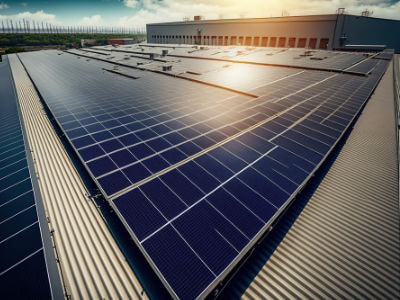
Industrial facilities typically have large, relatively unshaded roof areas suitable for substantial solar installations. Many factory roofs use sawtooth, monitor, or other industrial designs that can accommodate solar PV alongside existing rooflights and ventilation systems. We've installed factory solar systems ranging from 50kWp on smaller premises to over 1MW on major manufacturing facilities.
Strong Sustainability Drivers
Many manufacturers face increasing pressure from customers, regulators, and investors to reduce their carbon footprint. Major retailers and OEMs increasingly require their suppliers to demonstrate measurable progress on emissions reduction, often through Science Based Targets initiative (SBTi) commitments. Solar PV provides one of the most cost-effective and visible ways to demonstrate genuine sustainability action, supporting customer relationships, tender successes, and brand reputation.
Engineering Considerations for Factory Solar
Process Power Quality
Manufacturing operations typically have stringent power quality requirements, with sensitive electronic equipment, precision motors, and control systems requiring stable voltage and frequency. Modern grid-tied solar inverters from leading manufacturers including Fronius, SMA, and Huawei meet or exceed all relevant power quality standards, with no negative impact on connected equipment. We work closely with your facilities engineering team to ensure the solar installation integrates smoothly with your existing electrical infrastructure.
High-Voltage Connections
Larger factory installations frequently exceed the capacity of low-voltage connections and require connection at 11kV or higher voltages. We have extensive experience designing and installing high-voltage solar connections, including transformer specifications, switchgear arrangements, and protection systems. We coordinate with your DNO throughout the connection design and approval process, ensuring the installation meets all relevant network codes.
Health, Safety and Environment
Factory environments often have specific HSE requirements that must be respected throughout solar installation work. We're experienced in working in operational manufacturing environments, including those with explosive atmospheres (ATEX zones), chemical hazards, and confined spaces. Our project managers will work with your HSE team to develop site-specific risk assessments and method statements, ensuring the installation work integrates safely with ongoing operations.
Battery Storage and Process Optimisation
Battery storage can deliver substantial additional value for factory solar installations, particularly for operations with significant peak demand charges or shift patterns that don't align with solar generation. Industrial battery systems can perform multiple functions simultaneously: time-shifting of solar generation, peak demand reduction, frequency response services to the National Grid, and emergency backup power for critical processes.
Sophisticated energy management systems can integrate solar generation, battery storage, and process scheduling to optimise total energy costs. For example, energy-intensive processes can be scheduled to coincide with solar generation peaks, while flexible loads can be shifted to off-peak periods or solar-charging windows. This level of integration typically requires close coordination between energy management software and your manufacturing execution systems.
Capital Allowances and Tax Benefits
Solar PV installations qualify for capital allowances under the Annual Investment Allowance, allowing the full system cost (up to £1 million per year) to be written off against taxable profits in the first year. For typical factory installations costing £100,000-£500,000, this delivers immediate tax savings of £19,000-£125,000 at the standard corporation tax rate, dramatically improving after-tax returns and reducing effective payback periods.
For very large installations or businesses with limited current taxable profits, alternative arrangements including super-deduction allowances (where applicable) and operating lease structures may provide superior tax efficiency. Our finance team can model different funding scenarios to identify the optimal approach for your specific circumstances.
Combined Heat and Power Integration
Many manufacturing facilities operate combined heat and power (CHP) systems alongside grid-connected electricity. Solar PV can be integrated alongside existing CHP installations to provide additional flexibility and reduce overall energy costs. The combination is particularly powerful for facilities with significant heat demand, as CHP can be operated to follow heat demand while solar PV provides additional electricity during summer months when heat demand is lower.
Discuss Your Factory Solar Project
Every factory installation is unique, with specific requirements driven by manufacturing processes, electrical infrastructure, and operational patterns. Our industrial solar specialists will work closely with your engineering and operations teams to develop a tailored solution that delivers maximum value with minimum operational disruption. Contact us today on 0330 223 7664 to arrange an initial consultation at your premises.